Billable rate calculator
- Billable rate to charge, dollars an hour
- $129.08
- Computed on this page from the inputs below
- Loaded cost of the staff member a year
- $126,500
- Computed on this page from the inputs below
- Cost per billable hour
- $90.36
- Computed on this page from the inputs below
- Revenue at that rate for the year
- $180,714.29
- Computed on this page from the inputs below
Every figure on this site comes out of the numbers you type and the method printed beside them: your standard rates, your hours, your salaries, burden and overhead, your billable hours and your margin. There is no tax rate here, no wage law, no filing deadline and no benchmark fee. What your firm charges is your figure, not ours.
Email me this result
We will send you these figures and a link back to them. One email, nothing else unless you tick the box.
The figures above start from a worked example ($129.08). Change any input and the fee updates as you type, the way it will on the client record.
Download the Billable rate calculator worked example (CSV)
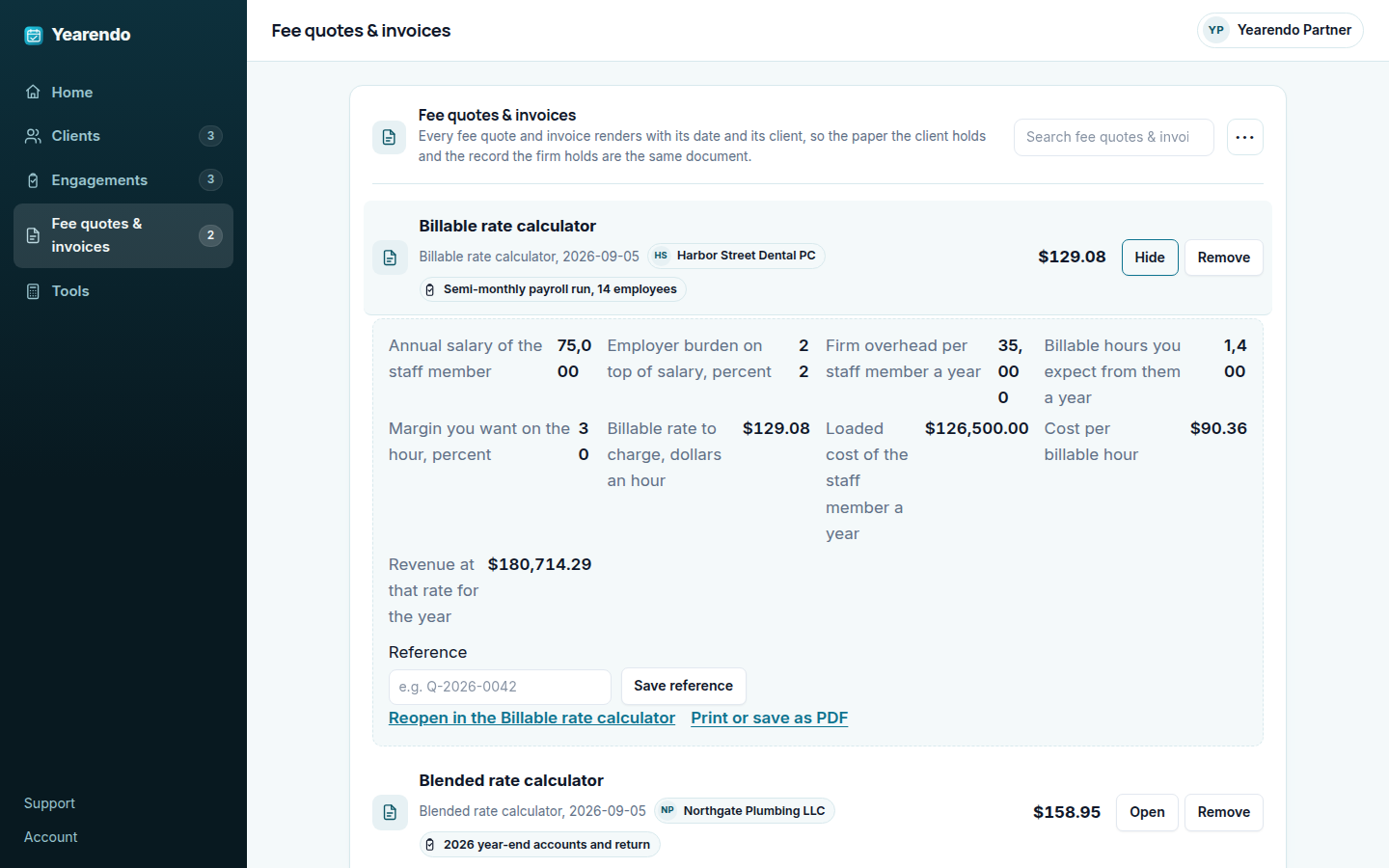
This worksheet works what a staff member's hour has to bill at from your own figures: their salary, the employer burden on top of it, the share of firm overhead they carry, the billable hours you really expect from them in a year, and the margin the firm wants on the hour. It gives you their loaded cost for the year, the cost of each billable hour, the billable rate to charge and the revenue that rate produces if the hours arrive.
What a partner asks before running the Billable rate calculator
Why is the cost an hour so much higher than the salary an hour?
Because the hour that bills carries the whole year: the employer burden, the overhead and every hour that was paid for but never reached an invoice. On the worked example a $75,000 salary becomes $90.36 of cost per billable hour before any margin.
How many billable hours should I put in?
The hours that actually reach an invoice, measured from last year's time records if you have them. A firm that budgets 1,800 and bills 1,400 has priced every hour a fifth too low, and the gap shows up as a margin that never arrives.
Is the margin applied as a markup?
No. The rate is cost divided by one minus the margin you enter, so on the worked example $90.36 of cost becomes $129.08, where marking the cost up by the same margin would give $117.47. Marking cost up by the margin figure is the arithmetic firms most often get wrong, and it understates the rate every time.
Yearendo Pro
Keeping the client behind the fee
The worksheets cost nothing. Pro begins where the client says yes: the fee turns into a client record, the client gets a payroll calendar and a year end, and next January the firm can still read what it agreed, what it ran and what was filed.
- Save a priced engagement and open it again next week
- Put two ways of pricing the same engagement side by side
- Your fee quotes and invoices without our name on them
- Send the fee quote from inside the client record rather than from your inbox
- Take the retainer without leaving the client record
- Connect QuickBooks or Xero to your account
$79per month, whole team
Start Yearendo Pro Free for 14 days. No card needed. PricingThe first 14 days are free and no card is asked for. Add a card during the trial and the first charge is on the day it ends; do not, and your workspace becomes read-only with nothing deleted. Yearendo Pro costs $79 a month for the whole firm. It is billed monthly and renews at that price each month until you cancel; the price and the renewal terms appear once more on the checkout page.
Where the constants in this tool come from
U.S. Small Business Administration, Business Guide: manage your business.